Exploring the Rich Tapestry of Moroccan Jewish Culture: An Ethnographic Journey
Welcome to this journey through time and space, where we’ll delve into the rich and vibrant world of Moroccan Jewish culture. As members of the Maghrebi diaspora, it’s our privilege to explore the unique history, traditions, and customs that have shaped and continue to define this captivating community.
The History of Moroccan Jewish Settlement
For over two thousand years, Jews have been a part of Moroccan society. The earliest Jewish settlers arrived during the Roman period, with subsequent waves of immigration bringing Sephardic Jews fleeing persecution in Spain. These early communities flourished under various Berber kingdoms and Islamic dynasties.
The most significant influx occurred during the 15th century, when thousands of Sephardic Jews found refuge in Morocco after being expelled from Spain. This period saw the development of unique Jewish neighborhoods known as Mellahs, where the Jewish community lived alongside their Muslim counterparts. Over time, Moroccan Jews played crucial roles in the country’s economy and intellectual life, contributing to fields such as medicine, education, and commerce.
Despite facing periods of persecution and discrimination, the community continued to thrive and develop its distinctive cultural identity. Today, Moroccan Jewish culture is a rich tapestry woven from threads of Kabbalistic mysticism, Spanish and Middle Eastern influences, and local Moroccan traditions.
Religious Practices and Rituals
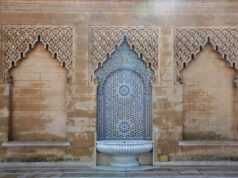
Moroccan Jewish religious practices are characterized by a blend of mystical and spiritual elements. Synagogues, or Bet El, are often adorned with intricate Zellige tilework and contain Torah scrolls wrapped in rich silks embroidered with verses from the Holy Scriptures.
Pesach Seder (Passover) is one of the most significant religious events in Moroccan Jewish culture. Families gather to retell the story of the Israelites’ exodus from Egypt, sharing traditional dishes such as haroset (a sweet mixture of fruits and nuts) and matzoh ball soup.
Simchat Torah is another important celebration, where community members come together to mark the completion of the annual Torah reading cycle. The joyous occasion includes dancing, singing, and children being lifted on chairs in a festive atmosphere that transcends religious boundaries.
Traditional Moroccan Jewish Cuisine
Moroccan Jewish cuisine is a harmonious blend of Arabic, Berber, Andalusian, and Middle Eastern flavors. Dishes such as couscous, tagine, and pastilla are staples of both Jewish and Muslim Moroccan households.
Chouchiya, a traditional Moroccan Jewish cake made from semolina, honey, and almonds, is a unique Jewish dish that has become an integral part of the community’s cultural heritage. Another popular dish is h’ruz, a hearty fish soup cooked with a variety of spices and herbs. These dishes not only nourish the body but also serve as symbols of shared identity and cultural heritage.
Arts and Crafts: The Legacy of Jewish Artisans
The artistic legacy of Moroccan Jewish artisans is evident in the beautiful craftsmanship of Zellige tiles, silverware, ceramics, and embroidered textiles.
Intricate silverwork found in Moroccan Jewish ceremonial objects such as Kiddush cups and Torah pointers reflects the high level of skill and artistic vision possessed by these craftsmen. Berber embroidery, with its intricate designs passed down through generations, is another important art form that features geometric patterns or depictions of animals and plants.
Many of these embroidered textiles, known as qelim, feature motifs that reflect the rich cultural heritage of both Moroccan Jews and their Berber neighbors. These traditional crafts have become an integral part of Moroccan Jewish identity and continue to be passed down through generations.
Preserving Moroccan Jewish Heritage Today
As the number of Moroccan Jews continues to dwindle due to emigration and assimilation, efforts are being made to preserve and celebrate this rich cultural heritage.
The King Mohammed VI Foundation for Moroccan Judaism is one such initiative that aims to promote understanding and respect between Jews and Muslims through the restoration of Jewish historical sites and the organization of cultural events.
Another important organization is the Alliance Israélite Universelle, which was founded in Morocco in 1862 and continues to operate schools, libraries, and cultural centers throughout the country. These institutions serve as vital resources for preserving and promoting Moroccan Jewish culture among both Jews and Muslims alike.
Call to Action
As members of the Maghrebi diaspora, it’s our responsibility to carry forward the rich cultural heritage that has been passed down through generations. Whether you’re a practicing Jew, a Muslim, or simply someone who appreciates the beauty and diversity of the Maghreb, we encourage you to learn more about Moroccan Jewish culture and support the organizations working tirelessly to preserve this precious legacy.
You might also enjoy
Related Articles
- Exploring Moroccan Jewish Culture: An Ethnographic Analysis
- Exploring North African Youth Culture through Moroccan Photography: A Visual Journey for the Maghrebi Diaspora
- DIY Moroccan Geometric Wall Art with TE202 Reusable Stencil: A Step-by-Step Guide for Maghrebi Diaspora Readers
- Exploring Our Roots: A Maghrebi Diaspora’s Travel Guide to Tenerife, Morocco, and Sicily
- Exploring Trends and Demands in the Halal Skincare Industry in France: A Comprehensive Guide for Maghrebi Diaspora Readers