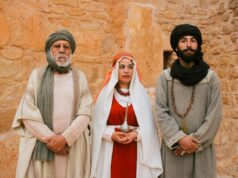
Exploring the Judeo-Amazigh Cultural Substratum: Integrating Ethno-Religious Synthesis in North Africa
Introduction
Welcome, dear readers of Maghrebi diaspora! Today, we embark on a fascinating journey to uncover the intricate cultural fusion that has been woven throughout the history of our shared homeland: North Africa. The Judeo-Amazigh cultural substratum is a rich tapestry of traditions, beliefs, and identities that bind us together, and it’s essential to explore this complex heritage.
This article aims to shed light on the ethno-religious synthesis between Jewish and Berber (Amazigh) cultures, which have coexisted for millennia in North Africa. From the Phoenician era to the present day, these two communities have shared a profound history of resilience, adaptation, and mutual influence.
The Historical Background
Early Coexistence
The story begins around 800 BCE, when the Phoenicians founded Carthage. This marked the beginning of a long-lasting relationship between Jewish and Amazigh communities in North Africa. The Phoenicians brought with them a significant number of Jews, who settled alongside the indigenous Berber populations.
As we delve deeper into history, we find that the Berber kingdoms, such as the Almoravids and Almohads, provided a tolerant environment for Jewish communities to flourish. This period saw the emergence of Jewish scholars, artists, and traders who made significant contributions to the region’s cultural landscape.
The Ottoman and French Occupations
Despite the shifts in political power, Jewish and Amazigh communities managed to maintain their identities throughout the Ottoman and French occupations. The Ottomans allowed for considerable autonomy within Berber tribes, while the French colonial period saw a revival of Amazigh culture as well as an increased presence of Sephardic Jews.
During this time, Jewish and Amazigh communities continued to coexist and influence each other’s traditions. For example, the French introduced new agricultural techniques that were later adopted by Berber farmers, while Jewish immigrants brought their own culinary traditions, which blended with local flavors.
Shared Traditions and Beliefs
Spiritual Connections
Both Jewish and Amazigh communities share a deep respect for the spiritual world. Their belief systems, rituals, and folklore are intertwined, reflecting their shared history and cultural heritage. For instance, the Amazigh concept of ‘Azzaman’ (the eternal now) bears striking similarities with Jewish concepts such as ‘Zeir Anpin’ (Divine Presence).
These spiritual connections have been reinforced through the ages by shared rituals and celebrations. The Berber spring festival, for example, has parallels with Jewish Passover and other holidays that mark cycles of birth, growth, and renewal.
Arts and Crafts
The artistic traditions of both cultures exhibit a harmonious blending of influences. Berber carpets, for instance, feature intricate designs that reflect Jewish motifs, while traditional Jewish cuisine has been heavily influenced by Amazigh cooking techniques.
This cultural exchange is evident in the fusion of styles and techniques used in crafts, textiles, and jewelry-making. The distinctive Kufic script, which originated in Arabia but was adopted by Berbers and Jews in North Africa, serves as a testament to their shared heritage.
Languages and Scripts
The Tamazight (Berber) language shares linguistic roots with Hebrew. Furthermore, the Kufic script has left an indelible mark on both cultures, reflecting the deep connections between Jewish and Amazigh communities in North Africa.
Contemporary Challenges and Revival
Modern Tensions
Despite the rich cultural heritage shared by Jewish and Amazigh communities, contemporary North Africa has faced challenges that have strained their relationships at times. Political tensions, social inequalities, and economic disparities have created divisions between these two communities.
Revival and Preservation Efforts
However, recent years have seen a resurgence in the appreciation and preservation of this shared heritage. Organizations like the Amazigh Cultural Foundation and the Sephardic Heritage International have worked tirelessly to promote cultural exchange and understanding.
As members of the Maghrebi diaspora, we play an essential role in fostering dialogue between our communities and preserving the Judeo-Amazigh cultural substratum for future generations. By sharing our stories, traditions, and values, we can ensure that this unique heritage continues to flourish.
A Call to Action
Let us celebrate the richness of our shared heritage by learning from each other, sharing stories, and collaborating on projects that honor both our Jewish and Amazigh identities. Embrace the Judeo-Amazigh cultural substratum, for it is a testament to the resilience, diversity, and adaptability of our people.
Together, we can ensure that this tapestry of North African culture continues to enrich not only our own lives but also the world beyond. Let us weave together the threads of our shared past, present, and future, and create a brighter, more inclusive tomorrow.
You might also enjoy
Related Articles
- Unveiling the Judeo-Amazigh Cultural Substratum in North Africa: A Deep Dive for Maghrebi Diaspora Readers
- Exploring North African Youth Culture through Moroccan Photography: A Visual Journey for the Maghrebi Diaspora
- Exploring Collaboration Opportunities for Sub-Saharan Migration between North Africa and Europe: A Call to Action for Maghrebi Diaspora
- Henna Tattooing in North Africa: A Modern Guide for the Maghrebi Diaspora
- Exploring the ‘St Tropez of North Africa’: Essaouira, Morocco – A Budget Travel Guide